Solvents
Isopropyl Alcohol, Acetone, Toluene, Xylene, White Spirit, Ethyl Acetate.
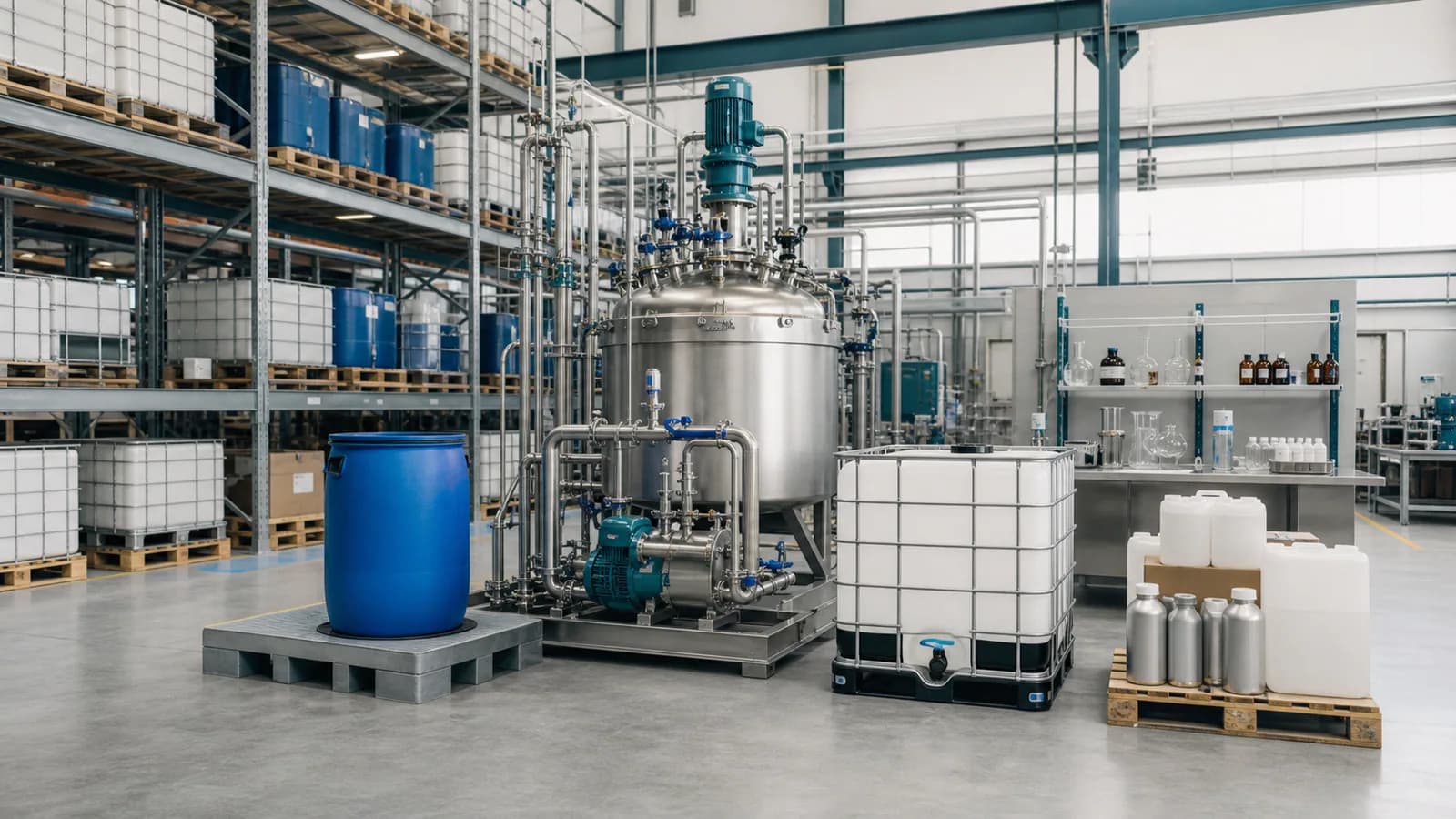

Grades, critical parameters and available technical documents are reviewed for each product, source and requirement.

Available specifications, safety data, analysis and transport information are checked for the material offered.

Packaging, loading, export documentation and delivery planning are aligned with product, volume and destination.
Four product families for industrial manufacturers - each leading directly to grades, specifications, documents, samples, and quotation support.
Isopropyl Alcohol, Acetone, Toluene, Xylene, White Spirit, Ethyl Acetate.
SLES, SLS, LABSA, Betaines, Non-ionic Surfactants, Fatty Alcohol Ethoxylates.
Mono Propylene Glycol, Mono Ethylene Glycol, Glycerine, Sorbitol, Fatty Alcohols.
Stearic Acid, Fatty Acids, Fatty Amines, Metallic Stearates, Esters.
Every industrial or specialty chemical order has to satisfy purchasing, the formulation lab and EHS at once. Bio Green Chem starts from the CAS number and the limits your process depends on: assay in caustic soda, heat stability in PVC stabilisers, APHA colour in glycols and solvents.
We confirm the CAS number, then weigh assay, chloride, iron, carbonate, APHA colour and moisture against your process limits. From caustic soda flakes or pearls to organotin or calcium-zinc PVC stabilisers, the grade is chosen for your end use.
Available SDS in GHS/CLP format, batch COAs and TDS are read side by side, so your EHS team can confirm that hazard statements, transport classification and specification limits agree. Importer questions on REACH and UK REACH are raised early.
Offers are compared by production route, impurity profile and pack: 25 kg bags or big bags for caustic soda, KOH and PAC powder; drums or IBCs for glycols, solvents, plasticisers and surfactants such as SLES and LABSA. MOQ and lead time are set out for each option.
Lab samples and trial drums for QC or formulation work are packed and labelled to suit their hazard class. Commercial loads are planned with UN number, class and packing group consistent across the invoice, packing list and dangerous-goods declaration.
Five steps from CAS number and target limits to grade review, SDS and COA checks, sample approval and a packed, labelled consignment.
CAS number, assay and impurity limits, application, pack, tonnage, delivery country.
Grade and physical form compared on assay and impurity limits.
GHS/CLP-format SDS, batch COA and TDS for EHS review.
Assay titration, Karl Fischer moisture or a PVC heat stability test.
IBCs, drums or bags, with UN number and class where classified.
Paperwork follows CAS number and hazard: a flammable solvent, caustic soda and a cosmetic raw material each get their own itemised set. REACH and UK REACH duties usually sit with importers.
Check Hazard Data Before You OrderCOA with Assay Result
Chloride, iron, carbonate or APHA colour
SDS (GHS/CLP Format)
H-statements, PPE, UN number and class
TDS for Formulators
Flash point, viscosity, bulk density, shelf life
Batch Release Limits
Minimum assay and maximum impurity limits
Manufacturer and Plant Location
Producer and country for REACH checks
ISO 9001 and ISO 14001 Certificates
Where held, scope checked against producing site
Chemical inputs for coatings, cleaning, care formulations, water treatment, polymers, process industries and more.
Paints, coatings, inks and adhesives rely on solvents, glycol ethers, coalescing agents and performance additives chosen to suit the resin…
Detergent and institutional-cleaning formulations combine alkalinity, surfactants, builders and sequestrants, and the balance changes…
Cosmetic and personal-care formulators work with oils, waxes, emulsifiers, humectants, surfactants, silicones and functional actives, each…
Home-care and everyday personal-care products, from surface sprays and laundry aids to hand wash, air fresheners and wipes lotions, draw…
Water and effluent treatment chemicals are chosen by treatment stage: coagulation and flocculation, pH correction, dechlorination…
PVC compounds, rubber goods and polyolefins need additive packages that protect the polymer during processing and give the finished part…
Industrial grades with available technical and safety documents confirmed per offer

The non-toxic replacement for lead stabilisers in PVC, supplied as a graded series covering medical and food-contact soft PVC, wire and cable, pipe, injection fittings, profile, foam and transparent product.

Suspension PVC resin (CAS 9002-86-2) graded SG1 to SG8 by K value, sourced from major Chinese producers. SG5 is the general-purpose grade for pipe and profile.

Two distinct chemistries for outdoor durability: UV absorbers that convert ultraviolet energy to heat before it breaks bonds, and hindered amine light stabilisers that interrupt the photo-oxidation cycle itself.

Caustic soda flakes (CAS 1310-73-2) are sodium hydroxide in thin flake form at 99 percent minimum. The large surface area dissolves fast, but it also makes the flakes dusty and quick to absorb atmospheric moisture.

Isopropanol (IPA, CAS 67-63-0) at 99.9% minimum, the standard cleaning solvent of electronics manufacture and a process solvent for pharmaceuticals, coatings and inks. Diluted to about 70%, it becomes the familiar surface disinfectant.

Industrial-grade guar gum powder for viscosity control, hydration, binding, suspension and water-loss management in oilfield, paper, textile, mining and formulated chemical applications.

Dipropylene glycol methyl ether, DPM, is the two-unit homologue of PM. Doubling the glycol backbone raises the boiling point sharply while keeping full water miscibility, which makes it a slow-evaporating coupling solvent.

Mono propylene glycol, MPG (CAS 57-55-6, EINECS 200-338-0), does much the same job as MEG but without the toxicity. That single difference is why it, not MEG, is used anywhere near food, people or animals.

Polyaluminium chloride, PAC (CAS 1327-41-9), is a pre-hydrolysed aluminium coagulant. Because the hydrolysis is done during manufacture rather than in the water, it works across a wider pH range and consumes far less alkalinity than alum.

Alkyl polyglucoside (CAS 68515-73-1, INCI Coco-Glucoside) is the rare non-ionic surfactant that stays effective in strong caustic. That alkali stability is why it is specified in heavy-duty and CIP cleaning formulations.
Grades matched on assay and impurities, with hazard data cleared before shipping.
Caustic soda grades, HS and UN codes, and how to choose between SLES, SLS, CAPB and APG.
Buying caustic soda? Compare flakes, pearls and liquid, technical, food and rayon grades, typical NaOH specifications, packaging, storage and shipping papers.
How SLES, SLS, CAPB and APG compare on foam, mildness, active content and handling, and how to combine them in detergents, shampoos and sulfate-free products.
Caustic soda flakes or pearls? Compare dissolving speed, dosing, dust and caking, and see which form suits batch make-up, automated dosing or soap making.
Tell us the chemical, assay limits, pack and tonnage; we check grade and hazard data, then quote.